Diagnosis of PMWS
In the absence of a clear causal agent, there are four aspect that lead to an accurate diagnosis:
Clinical signs exhibited by the group of pigs
The pathological signs exhibited by the group of pigs
The herd history over 3 months
The epidemiological history of the infected area.
Clinical signs exhibited by the group of pigs
|
The course of the condition can make definitive diagnosis difficult, initially. The major clinical signs are variable, depending largely on the secondary pathogens present on the unit. However, there are prime clinical signs: |
||||||
|
|
|
|||||
|
The nursery pigs do well until 30-40 lbs. Several producers actually comment that the
pigs have never looked better. |
As the condition starts, many producers note that
120-160 lb pigs start developing an ‘ileitis’ which does not respond to
treatment – either by vaccination or antimicrobial therapy. |
|||||
|
|
|
|||||
|
Some producers have commented on an increase in
coughing in the farrowing house. |
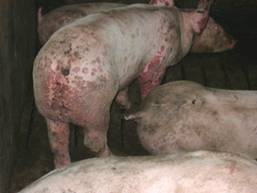
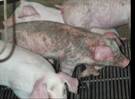
A couple of pigs 60 lbs or more develop Porcine
Dermatitis and Nephropathy Syndrome (PDNS).
This is often dramatic with several pigs in a pen being affected. Sporadic (rare) PDNS is normal. |
|||||
|
|
|
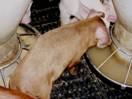
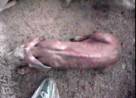
Increasing numbers of growing pigs suddenly loose their body condition. The pigs loose weight rapidly, some within 4 days. The pigs are generally of 30 lbs to 160 lbs bodyweight. The condition appears in a few pigs each day; these either die or are moved into the hospital pens. Males tend to be more affected than females and there is generally a litter effect. The farm now has full blown PMWS |
||||
|
|
|
|||||
|
There is an increase in respiratory
diseases in pigs less than 60 lbs or an increase in digestive diseases in
pigs older than 60 lbs – this largely depends on the prevalent conditions on
the farm |
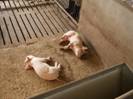
One characteristic of PMWS
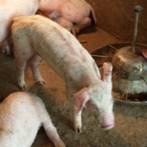
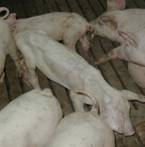
is that some pigs in the pen look normal whereas other are extremely
emaciated. |
|||||
|
|
|
|||||
|
The farm experiences a general increase in
severity and frequency of secondary pathogens and their clinical signs. Diseases which have not been seen for
several years reappear. |
||||||
|
|
|
|
|
|||
|
Glässer’s disease |
Salmonellosis |
Meningitis |
Greasy pig disease |
|||
|
|
|
|
|
|
|
|
|
|
||