The pigs who are they?
Dr John Carr
The pig is a fascinating mammal,
which as a group is extremely widespread over the planet. The pig has been able to adapt to all
climates below the snow line. With the
advent of human farming, one species – Sus scrofa has become worldwide
including inhabiting above the snow line.
The pig is present on all continents excluding Antarctica. The domestic/wild boar is a fairly basic
mammal, it has retained almost all of the basic mammalian characteristics and
therefore, are extremely adaptable to changes in the environment.
The
evolutionary relationship between different pig species
Mammals in general
Pigs and other even toed mammals
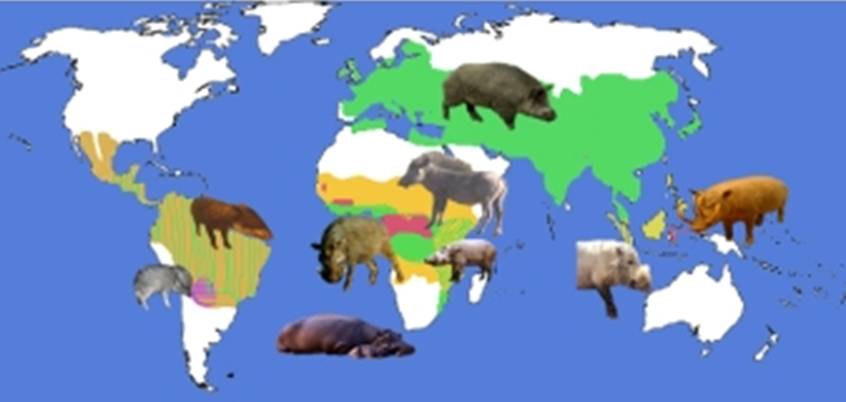
Global distribution
of species of the suborder Suina and Hippopotamidae
|
|
|
Hippopotamidae
|
|
Hippopotamus
|
|
Upper canines may measure 230 mm The lower canines may reach a length of 700
mm, of which 300 mm is above the gum line and they can weigh as much as
300g. The mouth can open to 150°
Nostrils are carried on top of the snout. The nostrils can be closed. The eyes are set high up and protrude.
Skin contains special glands that secrete a pinkish
substance known as “blood sweat” Skin
contains a large amount of fat. The
skin must remain moist or it will crack. In the Pigmy hippo the
body is without hair, except for a few bristles on the lips and tail
The foot bones are separate and all toes support
weight. The terminal digital bones
have nail-like hooves.
Stomach is complex with three chambers, but it is
non-ruminating.
|
|
Hippopotamus
amphibius
|
(I 2-3/2-3, c1/1, pm 4/4 m 3/3) x 2 = 40-42
|
Seasonally polyoestrus. In some areas there are peaks in breeding
with births occurring at times of maximum rainfall.
Interval between births often 2 years
|
Oestrus lasts 3 days.
Gestation: 227- 240 days
|
Head and body length 290 – 505 cm
Shoulder height 150 – 165 cm
|
Males are larger on average
1,000 to 4,500 kg
|
|
Hexaorotodon liberiensis
|
(I 2-3/1, c1/1, pm 4/4 m 3/3) x 2 = 38-40
|
Oestrus: 28 days lasting 2-3 days
Gestation: 184-204 days
|
Head and body length 1,500 – 1,750 mm
Shoulder height 700 – 1,000 mm
|
160-270 kg
|
|
|
|
|
|
Upper canines form tusks, directed
downwards not outwards or upwards as in Suidae, and
they are generally shorter. Tusks are
more slender.
Tusks average length is 40 mm. There is a space between the canines and
premolars The premolars increase in
size to first to last. The molars
have square crowns with four cusps The
molars are high crowned (hypsodont) rather than low
crowned (bunodont).
Legs are long and slim and the
hooves are small. There are four
digits on the forefoot, the two lateral ones being reduced and do not touch
the ground. There are two functional
digits on the hind foot. There is a
vestigial median digit on the back of the hind foot in Pecari
and Tayassu but not in Catagonus. The third and fourth foot bones are united
at their proximal ends (as in ruminants – but not suids). Elongated snout, longer than other
peccaries Tails have reduced number of
vertebrae - 6-9.
|
|
Scent gland 75 mm in diameter and
125 mm thick on the rump in front of the tail. Emits a specific odour. Hair can be made erectile when excited.
The stomach is two chambered but
more complex than in suids but none
ruminating.
Milk is lower in fat than Suidae 2 pairs
of mammae
The Pecarri
tajacu
is gregarious – group size of 2 to 50 but usually 5 to 15, with groups
of both sexes and all ages. Several groups or sounders may group
together. Tayassu
pecari may occur in large groups or herds of up
to several hundred animals. Hierarchy
is present, dominant animal male
|
|
Catagonius wagneri
|
(i 2/3, c 1/1, pm 3/3, m 3/3)
x 2 = 38
|
Mating occurs in April and May with the young being born
in August and September (early spring)
|
Litter size 1-4, usually 2-3
|
Head and body length of about 900 – 1,112 mm
Shoulder height 520 – 690 mm
|
29.5 – 40 kg
|
|
Pecari tajacu
|
Oestrus Average 24 days and oestrus lasts 4 days
Gestation round 145 days
Litter size 1-4, usually 2.
|
Head and body 750 – 1,000 mm
Shoulder height 440 – 500 mm
|
14-30 kg
|
|
Tayassu pecari
|
Gestation: 156 – 162 days
|
Head and body length 900 – 1,300 mm
Shoulder height 440 – 600 mm
|
20-50 kg
|
|
Pecari maximus
|
|
|
|
120-137 length
|
40-50 kg
|
|
|
|
Babyrousa babyrussa
|
(i 2/3, c 1/1, pm 2/2, m
3/3) x 2 = 34
|
Early months of the year. Can produce two litters per year
|
Oestrus:28-42 days with oestrus of 2-3 days
Gestation: 155 to 158 days
Litter size 1-2
|
Head and body length 875-1065 mm
Shoulder height is 650-800 mm
|
Upper incisors curve upwards and pierce the nasal
skin.
The snout is grooved
Only two pairs of mammae. Biloped stomach.
|
|
Wart Hog
|
|
3rd
Molar composed on set of cylinders of dentine set in cement. No upper incisors in P. aethiopicus
Warts are
prominent only on the males, are skin growths and has no bony support or
core. They are located on the side of
the head and in front of the eye.
|
|
Phacochoerus africanus
Phacochoerus aethiopicus
|
P. africanus: (i1/3, c1/1, pm 3/2, m 3/3) x 2 = 34
P. aethiopicus (i0/3-0, c1/1, pm 3/2, m 3/3) x 2 = 32-26
|
|
Females are polyoestrus,
oestrus lasting about 72 hours at intervals of 6 weeks.
Gestation: 150 – 175 days
|
Head and
body length 900-1500 mm
Shoulder
height is 635 – 850 mm
|
Weight is 50 -150 kg
|
|
Red River Hog and
the African Bush Pig
|
|
Upper tusk
76 mm – point downwards and wear against the lower ones. Lower tusk 165-90 mm.
Male has
warts in front of the eye, which
although they protrude 40 mm, frequently are not conspicuous as they are
concealed by facial hair.
9-15 individuals in a sounder. May travel in
up to 60 individuals. The immature to
adult ratio is generally 2:1
|
|
Potamochoerus porcus
Potamochoerus larvatus
|
(i 3/3; c 1/1; pm 4/4; m
3/3) x 2 = 44
(full mammalian dention)
|
|
Gestation: 120 days
|
Head and body length – 1,000 to 1,500 mm
Shoulder height 585 - 965 mm
|
Weight is 46-130 kg
|
|
Giant Forest Hog
|
|
Large skull contains a large depression in the
roof. The nose is very prominent Preorbital gland
is present, marked externally by a slit on the naked area of the face in
front of each eye.
|
|
Hylochoerus meinertzhageni
|
( i 3/3, c 1/1, pm 4/4, m
3/3) x 2 = 44
Canines are set horizonally.
|
Breeding is continous. Mating peaks in East
Africa in the latter part of the rainy season.
|
Gestation: 151 days
|
1,300 to 2,100 mm long. Shoulder height is 762 – 1,100 mm.
|
|
|
Suidae
|
|
Oesphageal diverticulum. Pyloric torus – bile duct close to stomach. Preputial diverticulum.
Carpal glands. Testes upside
down. Lymph nodes reversed
anatomy. Multipapillary
kidney. Piglets born with 8 needle
teeth. Some of these features may be
in other suina.
Hippopotomus lymphnodes
have similar lymphoid anatomy. Sus scrofra, Sus salvanius – no warts.
Other species of Sus have warts – often 3 pairs
|
|
Sus scrofa
|
( i 3/3, c 1/1, pm 4/4, m
3/3) x 2 – 44
The canines in males the inferior surface is
narrower than the posterior surface.
The female canines are small versions of the male.
|
Breeding occurs throughout the year in the tropics,
birth peaks shortly before or just after the rains. In the temperate regions the young are born
in the spring.
|
Oestrus 18-24 days
Gestation: 112 – 120 days
Litter size: 6-12 up to 40 domestic breeds
|
900 – 1,800 mm.
Shoulder height 550 – 1,100 mm
|
40-350 kg
40-350 kg
|
|
Sus barbatus
|
|
Sus bucculentus
|
|
Sus cebifrons
|
|
Sus celebensis
|
|
Sus philippensis
|
|
Sus verrucosus
|
|
Sus salvanius
|
500-710 mm. Shoulder height 250-300 mm. .
|
6.6 to 9.7 kg
|
|
|
|
|
|
|
|
|
|
|
|
|
|