Murdoch University
Vet 329 Introduction to
Clinical Examination
Intensive Industries – Pig,
Poultry and Aquaculture
APPs for your pocket PC and smart
phone
A successful veterinarian is one whose clients have no sick or compromised animals – an extremely difficult achievement. The clinician needs to remember that the clinical disease is only the terminal cause of death. It is imperative that the veterinarian concentrates on maintaining the animal’s health rather than treating its diseases.
Making an accurate diagnosis is the key to successful veterinary practice.
A diagnosis is to identify:
1. If there is a problem – Vet 246 (Animal and Society) and Vet 329 (Intro to Clinical Exam)
2. The cause of the problem – Vet 437 (Medicine course notes)
3. Practical solutions to the problem – Vet 437 (Medicine course notes)
4. Means of preventing the problem occurring again – Vet 530 (Clinical rotations)
Within intensive industries, the pig will be used as a model food supply animal.
Is there a
problem?
This is the core of Vet 329: - making a diagnosis.
In Food Supply Medicine there are 7 key areas essential in assisting the clinician to make a diagnosis:
a. Taking a history
b. The examination of the individual pig
c. Post-mortem examination of the individual pig
d. Examination of the group of pigs
e. Examination of the environment of the pig
f. Examination of the farm’s performance
g. Suggesting practical solution to the problem
1. Taking a history of the problem
Clinicians have two ears and one mouth and should therefore listen twice as much as they talk.
Listening to the client and asking the correct questions is an essential component of making a diagnosis.
The clinical history will be practiced within the practical labs in Vet 329.
Consider the following line of enquiry:
|
What has the client seen? |
is the pig eating, defectating, urinating, coughing, sneezing, lame or dying |
|
Severity of the problem? |
how many are sick or dead |
|
Location of the problem? |
which pens or age groups are affected |
|
When did the problem start? |
time, date, place |
|
How is the problem progressing? |
are more pig getting sick within the group |
|
More than one problem? |
how many different problems in same group |
|
Epidemiological consideration? |
has the problem spread to other groups |
|
Are there any other factors? |
which the client thinks is relevant to the situation |
|
What has the client done? |
to alleviate the problem, what was the result of the action |
2. The
examination of the individual pig
In general practice a detailed individual examination of a pig is rarely performed, but it is essential that you know the basics.
|
Review: |
|
|
|
Know: |
Clinical examination of a cooperative and an uncooperative pig |
|
|
Info: |
Auditing the welfare of the pig |
Review – Vet 246 Animals in
Society Course Know: Required reading
for Vet 343 Info: - useful information
to add completeness to the course
3. Post-mortem technique
|
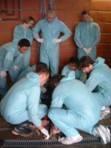
This is taught in Vet 343 and Vet 530. In Food Supply Medicine the postmortem examination is a cornerstone to health maintenance. The postmortem routine needs to be methodical, as generally the veterinarian is interested in the likely cause of death of the individual. The food supply veterinarian is also interested in reviewing the clinical presence or absence of other specific pathogens. |
|
|
|
Info: |
||
4. Examination of the group of pigs
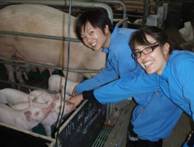
Examination of the undisturbed group
|
Know: |
Understanding the different patterns exhibited by lying pattern |
Examination of the disturbed group
|
Know: |
Understanding the patterns exhibited by the defecation pattern |
|
Condition scoring pigs and the difference in chronic, acute and subacute disease timelines |
|
|
Review: |
Understanding normal behaviour patterns- see Animal in Society notes |
|
Know: |
Examination of the farm
|
Know: |
||
|
Info: |
||
|
|
|
|
5. Examination of the pig’s environment
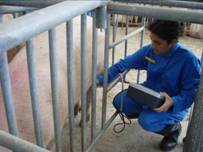
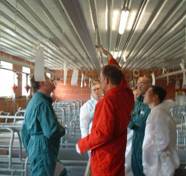
You will be expected to know how to measure and record:
|
Type of drinker; height; flow and associated animal expectations |
|
|
|
Feeder space; feeder type; quantity of feed and basic make up of the feed |
||
|
Space and stocking density, impact of worn equipment |
||
|
Ventilation patterns, temperature, humidity and gas concentration expectations |
||
|
Know: |
||
6. Examination of the farm performance
In any production system a systematic approach is required to analyse any farm records. This will be covered in more depth in Vet 530. At this stage an understanding of the basic production expectation for a farm will be reviewed.
|
Know: |
7. The basis of providing a practical solution
to the identified problem
Once a problem has been correctly identified, the clinician has to prescribe a treatment plan. Within Vet 329 an introduction to the various treatment routes will be presented.
The student will be expected to understand:
|
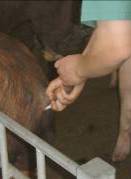
Injection techniques in the pig: the site for intravenous, intramuscular and subcutaneous injections. Euthanasia in the pig Knowledge of feed and water as a medication route and some problems associated with these routes Being able to calculate the dose rate for a variety of animal groups. |
|
|
|
Know: |
||
|
Calculating medication doses |
||
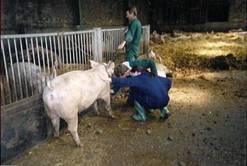
Preparation for the practical class
Properly dressed with clean protective clothing – overalls and gumboots
Thermometer
Stethoscope
Penlight
Calculator
Notebook and pen
PDA (if owned)
Name-tag (please wear to all classes)
|
Review: |
Examination in Vet329
Example of typical farm issues – using
Murdoch Pig Unit as an example