| |
|
Reason: |
- To reduce the risk of discomfort to the
sow's udder which may lead to piglet starvation, overlaying or
savaging.
- To prevent facial damage to litter mates.
 |
 |
Facial necrosis in a
14 day old piglet
|
Udder damage through piglets fighting over
the teats |
- Poor teeth clipping is a major cause of
joint ill.
- There is a lot of evidence that not teeth
clipping has no production disadvantage and may even enhance
growth of weak or large litters.
|
|
Equipment: |
-
New teeth clippers should be purchased as
soon as the old pair show signs of wear. Ideally replace every
6 months. Depends on the size of the unit
-
There should be two teeth clippers on a
unit/farm. One should be in disinfectant the other in
use
-
The teeth clippers must be kept clean at
all times and must be cleaned between litters and then dipped
in fresh surgical spirit or alcohol
-
Clean alcohol must be used each day the
clippers are in operation
-
After use the clippers should be cleaned in
hot soapy water using a tooth brush to clean the blades and
the handle
-
The clippers should then be placed in
surgical spirit for 10 minutes
-
Store dry within a plastic bag to stop any
dust getting on them
-
Do not sterilize by boiling as this will
blunt the clippers
-
Grinding the top 1-2 mm of eye teeth
instead of clipping may be less painful to the piglet and may
also reduce damage to mouths. It may not be as effective at
reducing damage to litter mates and sow.
-
Grinding can be more time consuming than
clipping until you are familiar with the equipment get
training
|
|
Prior to teeth clipping: |
-
The clippers should be checked to ensure
that they are suitable for removal of the eye teeth
-
The blades must meet evenly, they must not
cross
-
When placed to the light, light must not be
seen to come through the blades
-
There must be a straight cut
|
 |
 |
 |
|
Dirty teeth clippers |
Blades do not
meet due to wear |
Damage to the blades |
|
|
|
|
|
Procedure:
|
-
Teeth clipping must be carried out in the
first 2 days of life, or 3 days for weak or sickly piglets.
Teeth clipping is advised on any fostered piglet
-
Wash hands before teeth clipping
-
Piglets of low birth weight (i.e. less than
1 kg) may be better left with their teeth intact.
-
Pick up the piglet by one hind leg above
the hock.
-
Dip the finger which goes into the piglets
mouth in iodine or other suitable disinfectant
-
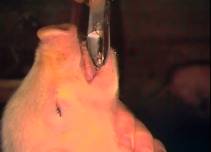
Support the animal between the body and
forearm and insert a finger into the corner of its mouth to
open the jaw.
-
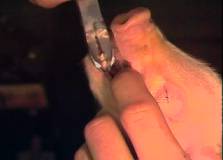
Cut each tooth as close to the gum as
possible and remove all debris from the mouth.
-
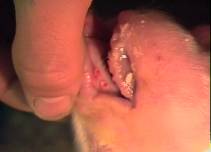
Care should be taken to ensure that neither
tongue nor gum are cut, and that the gum is clean.
-
Keep the clipper clean and dip in
antiseptic between each piglet.
-
Return piglets to the sow as soon as
possible.
|
|
|
|
|
|
|
Other considerations:
|
-
Handling the piglets with confidence tends
to reduce both stockperson and animal stress.
-
It is important to confine the pigs being
treated in as warm, dry and clean an area as possible.
-
The playing of a radio can help to settle
the sows and piglets
-
Good farrowing pen hygiene and an effective
cleansing program will reduce the incidence of infection of
wounds.
-
Always wash your hands before docking.
-
If outdoors, consider your safety
and work in
pairs. A lactating sow with her litter can be very dangerous
|
Consequences of poor teeth clipping:
|
 |
 |
 |
|
Sharp tooth remaining |
Infection of the gums |
Skin infection spreading to the nose
|
|