Coccidiosis of Piglets
|
Causal agent |
Isospora suis. This is a coccidia a parasite |
|
|
Age group |
Occurs between 8
and 15 days of age. Chronic cases can
be seen post-weaning |
|
Clinical signs
|
||
|
Acute
|
Scour tends to occur in individual pigs from
approximately 6 days of age, but most of the litter scour at 8-10 days. At the start of diarrhoea, vomiting may be
seen |
|
|
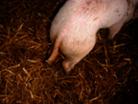
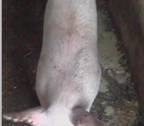
Diarrhoea ranges from white to pasty cream
faeces through to a yellowy watery diarrhoea |
||
|
Piglets tend to be in poor condition, hairy
and growing more slowly than other piglets within the litter |
||
|
Mortality rates reach 20% in acute cases |
||
|
The scour is not responsive to antibiotic
therapy -excluding sulph medicines |
||
|
Piglets which survive often become unthrifty
finishers when exposed to high pathogen concentrations, as they have little
passive immunity and an immature gut |
||
|
Failure to recognise the disease leads to increased
farrowing house mortality, poorer weaning weights and increased post-weaning
problems |
||
|
Sub-clinical |
Most farms will have Coccidiosis at a low
level affecting piglet performance |
|
|
Infectivity |
||
|
The coccidial egg, or oocyst infects young
piglets by mouth, and relatively heavy infections are needed to cause
disease. After ingestion, the
organisms move down to the small intestines, where they invade the gut wall. In successive stages of a complex life
cycle, they emerge from the wall at 5-9 days and again at 11-14 days after
infection, and it is this emergence which causes diarrhoea. |
||
Transmission
|
||
|
For clinically significant disease to occur,
piglets need to be infected with relatively high numbers of oocysts |
||
|
Oocysts survive well in farrowing house
environments. They are resistant to
drying and most disinfectants |
||
|
Infection from the sow plays only a small
part in disease development. Sows excrete
a different coccidia called Eimeria |
||
|
Most piglets are infected by oocysts carried
over from previous litters |
||
|
Once the piglet starts scouring, the
intestinal wall is damaged, and treatment will not work effectively |
||
|
Failure to recognise the disease leads to
increased farrowing house mortality, poorer weaning weights and increased
post-weaning problems |
||
|
Incubation
period |
||
|
The incubation period is 5 days |
||
|
Post-mortem
Lesions |
||||
|
There may be
very few postmortem findings – steatorrhea (increase of fat in faeces). Some times there is a generalised
enteritis. Scrapes from the intestinal
wall may reveal the coccidial parasite.
Histological examination are also used, however, note coccidia are
also very common (normal?) |
||||
|
Diagnosis |
||||
|
Can be very
difficult. Coccidial oocysts are only
excreted in the faeces long after the clinical disease has passed |
||||
|
Response to
treatement with Baycox (toltrazuril) Europe or Marquis (15% ponazuril) US- not
licenced for pigs. Dose 7mg/kg. For Marquis use one tube (127g) into 4
litres of water and administer 4 ml orally per 4 to 10 day old piglet. |
||||
|
|
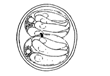
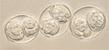
Isospora suis oocyst only has two merozoites within the egg |
|
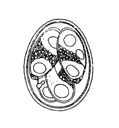
Emeria (from the
sow) has four merozoites within the egg, allowing easy differentiation |
|
|
Treatment |
||||
|
Give electrolytes |
||||
|
Give extra bedding. Stop creep feeding. Increase heat to piglets |
||||
|
Treat with Toltrazuril
an oral preparation given at 4 and 10 days of
age. Note this can make the pigs vomit.
Sulpha-antibiotic medicines may also be used as treatment |
||||
Control
|
Prevent carry over of oocysts from previous
litters. Clean the farrowing house with an occide disinfectant
such as Oocide (Antec International) |
|||
|
Control of rapid multiplication in infected
piglets can be achieved by early and sometimes repeated treatment |
||||
|
Reduce/cease cross-fostering after 2-3 days
of age |
||||
|
Use as a preventive measure Toltrazuril oral doser.
Pigs should be dosed at 4 and 10 days
of age. Note some piglets vomit after
being treated |
||||
|
Sows should be washed/disinfected before
entering the farrowing house |
||||
|
Do not enter pens |
||||
|
Use separate brushes, forks, shovels in each
farrowing room |
||||
|
Control flies |
||||
|
Reduce draughts and other environmental stress factors |
||||
|
Common
differentials |
||||
|
Other causes of
preweaning diarrhoea. Stress induced
diarrhoea |
||||
Non Specific Colitis
|
Causal agent |
None
identified. Diarrhoea of weaned pigs of any age from weaning to
slaughter. Diarrhoea can occur within
hours of consuming a new batch of pelleted feed and they can dramatically cease
within hours of the removal of the suspect feed. Considered important factors are nutrition,
infectious agents, and draughts |
|
Age group |
Weaning
to slaughter pigs, most common between 25-30 kg pigs |
Clinical signs
|
|
|
|
Softening of faeces with/without
mucus and/or blood |
|
Diarrhoea can develop |
|
|
Decreased
growth rate. Feed conversion
increases |
|
|
Most
common between 8-10 weeks of age |
|
|
More
commonly seen in fast growing pigs on high density diets |
|
|
Infectivity |
|
|
Agent
not recognised, but can appear to spread around and between farms The
syndrome classically occurs with a particular feed and when this is changed
the ‘disease’ disappears. Nutritional
factors known to affect digestion are: Presence
of trypsin inhibitors in peas, beans and soya Poor
quality fat |
|
|
Post-mortem Lesions |
|
|
|
The
colon and small intestine may demonstrate areas of inflammation both acute
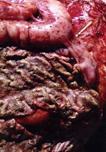
and chronic. The spiral colon contains
abundant watery green or yellow mucoid and frothy contents. In some cases there may be no gross
lesions. The
photograph shows raised rugae in the inside of the large bowl but few other
lesions |
|
Diagnosis |
|
|
Based
on the clinical signs and absence of other specific organisms |
|
|
Treatment |
|
|
|
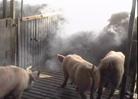
Improve
the environment, remove draughts and ensure that the stocking rate is correct
– photo shows a growing shed being examined for draughts |
|
Do
not place pigs into buildings which are damp and cold |
|
|
Check
and clean the water supply |
|
|
Ensure
the correct pig is placed in the building |
|
|
Change
the feed to a meal |
|
|
Establish
an all-in/all-out programme |
|
|
Common
differentials |
|
|
Other causes of
post-weaning diarrhoea |
|