Novel Influenza A (H1N1)
Dr John Carr
Portec Australia and Murdoch University
|
The
emergence of a new influenza strain in April 2009,
has caused a great deal of public concern.
Influenza is one of a few pathogens that can spread between man and
other animals – zoonotic. It is
particularly worrisome because it can move between very different animals –
not just between mammals but also between birds and man. Most pathogens can only move to closely
related species – for instance between man and monkeys. The
most serious effects of influenza are that it can kill. The mortality rate with novel influenza
viruses has been in excess of 90%.
Therefore, there was naturally a great deal of concern both real and
political. AS the outbreak and initial
mortalities occurred in Mexico, this country effectively went into lockdown
from the end of April into May.
However, a few tourists from Mexico left during the end of April and
spread the novel virus around the world. Fortunately,
while the new virus could spread from person to person, the rate of spread
and relatively slow for an influenza virus and the mortality rate was low,
allowing countries to invoke a series
of measures to identify high risk visitors. These were placed in quarantine
with limited movement and contact with the outside world, until demonstrated
to be negative or not shedding. |
||
|
Why the reference to swine
influenza? In
1918 the world suffered a major influenza pandemic, in which 50 million or
more people died. In North America
this virus mutated to a point where it could move into pigs. Here it has become the predominant strain
of influenza virus is pigs and the condition is called swine influenza. |
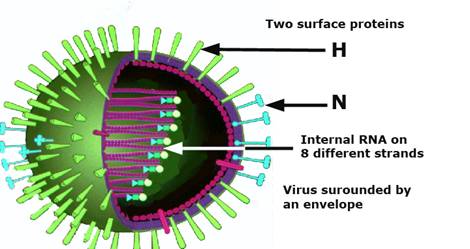
Cartoon
of the influenza virus showing major components |
|
|
Over
the last 90 years, this particular H1N1 has caused transient problems in pigs
and has over the last 30 years been joined with a couple of influenza virus
strains, H3N2 for example. It has been
recognized that the resident H1N1 strain continued to evolve in the pig and
from time to time infected people.
However, people infected only rarely passed the virus on to other
people. The particular Novel H1N1 of
April 2009 unfortunately can clearly pass from person to person. The transmission of influenza virus
strains is through the respiratory tract and the virus is killed rapidly in
the air. Meat and meat products will
not transmit the virus. |
||
|
Is this a threat to Western
Australia? Yes
on two fronts. It is a threat to the people of Western Australia who may contract the virus from
an infected person, albeit the infection can only spread for a couple of
days. While it is now expected the
mortality will be low, people with clinical influenza of any strain can be
seriously sick and require hospitalization.
Seasonal influenza – many of which are H1N1 viruses – officially kills
35,000 Americans a year – mainly people who are unfortunately infirm. |
||
|
It is a threat to the pigs of Western Australia.
While the novel virus has not been found naturally in pigs – currently
including Mexico, its transmission to pigs occurred in May 2009 in
Canada. Here a clinically sick
worked, within 2 days of arriving from Mexico, transmitted the virus to pigs
he was in contact with. The pigs
became sick and recovered, but there would be economic and production losses. Australian pigs are unique as they are free
of all influenza strains. This is an
important part of our Biosecurity programme and we should work to keep our
negative status in both our commercial pig herd and the feral pig population. |
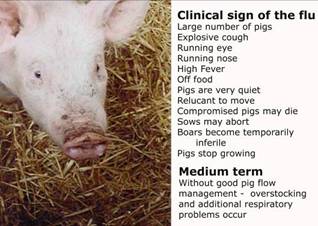
Swine influenza in a
British Pig |
|
|
Recommendations ·
No staff with clinical signs of influenza should have contact with
pigs. ·
No staff who believe they have had contact within 3 days of a person
exhibiting signs of Novel H1N1 should have contact with the pigs ·
All visitors from abroad should have no contact with pigs for 7 days
after arrival. |
||
|
What if a pig farm becomes
positive to influenza? Swine
Influenza is an exotic disease of pigs and therefore, the government
veterinarians would have the final say in procedures. Euthanasia
of all the pigs and quarantine of in-contact farm staff would be the most
effective measure. However, influenza
does not live long in the environment and measures could be designed to
eliminate the virus from the farm, without the need to destroy all the pigs,
but this would be on a farm by farm basis.
The major complicating factors are: piglets are constantly being born,
and initially, these will be provided with no protection via their mothers
colostrum, and
nursery weaners, who become infected after their colostrum
cover has waned. Note all infected
pigs would become and remain antibody positive, complicating further testing.
If no action was taken, then the specific
swine influenza strain would progressively spread throughout the pig industry
and become a persistent drain on production, as has happened in almost all
other pig producing nations. |
||
For further information visit: www.portec.com.au