Nosema
|
Causal agent |
Nosema apris and Nosema ceranae This is a microsporidia – unicellular
parasite. The spores are large oval
bodies 4-6mm long and 2-4mm wide |
|||||||||
|
Age group |
||||||||||
|
Egg |
Larvae |
Pupae |
Adult - worker |
Drone |
Queen |
|||||
|
No |
No |
No |
Yes |
Yes |
Yes |
|||||
|
Clinical signs |
||||||||||
|
|
Mainly seen in the winter and spring after periods of bad
weather |
|||||||||
|
Mainly affects workers, but can affect drones and the
queen |
||||||||||
|
|
Results in “dysentery” where the works defecate in the
hive rather than during “cleansing flights”.
The dysentery can be seen as yellow stripes on the outside of the hive
or even inside the hive. |
|||||||||
|
The worker may appear to have an increased girth of her
abdomen. There may be a missing sting
reflux. An affected queen might lead
to supersedure of the queen. |
||||||||||
|
|
Egg production drops as the queen’s ovaries degenerate |
|||||||||
|
|
There can be a large number of dead bees in the apiary, but
in general bees die away from the hive. |
|||||||||
|
Secondary
infections |
Worker bees are unable to fly move by crawling with
disjointed wings. |
|||||||||
|
|
Also appears to be related to Black Queen Cell Virus |
|||||||||
|
|
Has a role to play in Colony Collapse Disorder |
|||||||||
|
Infectivity |
||||||||||
|
|
The spores are
extremely long lived and are not destroyed by freezing Newly emerged bees
are free from the infection |
|||||||||
|
Transmission |
||||||||||
|
|
The bees become infected
through faecal materials. Generally
after being confined to their hive. |
|||||||||
|
Post-mortem
Lesions |
||||||||||
|
|
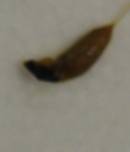
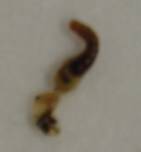
The healthy ventriculus is straw brown and the individual
circular constrictions can be clearly seen. In infected bees the ventriculus
is white, soft and swollen and the constrictions are obscured |
|||||||||
|
3 2 1 |
||||||||||
|
||||||||||
|
The digestive tract can be easily obtained from a bee. Remove the bees head. Grasp as much of the stinger as possible with a pair of fine tweezers and
then with a steady, gentle pull withdraw the entire digestive tract. |
||||||||||
|
Nosema affects pollen digestion, thus reducing the
life of the bee |
||||||||||
|
Under development of hyopopharyngeal
glands may be seen |
||||||||||
|
Diagnosis |
|
|
|
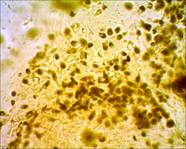
Place a glass-slide collect
faecal material from worker bees near the hive entrance. Scrape off the deposit, mix with water and
make a wet mount. |
|
Queen bees can be
examined by placing them on a small petri dish and allow them to walk
freely. Within an hour the queen will
have defecated – drops of clear, colourless liquid which can then be
transferred by a capillary tube. |
|
|
Microscopic
examination of the ventricular contents. |
|
|
Take a whole bee and
macerate in water. Examine the fluid
to reveal the Nosema spores |
|
|
|
The number of spores
can be calculated using a haemocytometer. |
|
|
May also recognise an Amoeba when looking for Nosema. Amoeba Malpighamoena mellificae). This does not appear to be significant. However, it can result in cysts in the Malpighian tubules – revealed by gentle crushing the Malpighian tubules with a cover slip. |
|
Other protozoa that may be recognised include flagellates of the Crithidia spp. |
|
|
Treatment |
|
|
|
Fumidil B (Fumigillin) |
|
Disinfect honeycomb and utensils |
|
|
Some evidence that thymol may be effective |
|
|
Be careful when manipulating the frames. If bees are trapped and quashed, they will spread Nosema. |
|
|
Control |
Heat treat for more than 50°C for 24 hours to kill spores |
|
Ensure that the crude protein content of bees is above 40%. When bees drop to less than 30% they become more susceptible to Nosema. |
|
|
Shook swarm technique may be helpful |
|
|
Ensure all bee keeping equipment is clean |
|
|
Be careful of other people bee equipment |
|
|
Do not reuse old combs from colonies that have died out. |
|
|
Do not exchange combs between colonies |
|
|
Common differentials |
|
|
|
|
|
Zoonosis |
None |